The English Springer Spaniel — FCI breed standard
What an English Springer Spaniel should look like. 😉
English rendering of the Polish overview below; consult the FCI publication for the official wording.
Origin: Great Britain
Utilisation: A flushing dog — its name refers to springing game — also used for retrieving after the introduction of firearms.
FCI classification:
Group 8 — Retrievers, Flushing Dogs and Water Dogs.
Section 2 — Flushing Dogs.
Standard number 125.
Subject to a working trial.
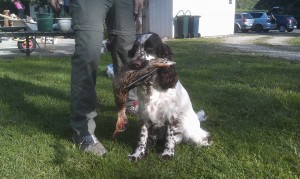
Brief history: The English Springer Spaniel is an old breed with a long history of pure breeding. Its original role was finding and flushing game for nets, falcons or greyhounds. Today its working role includes finding, flushing and retrieving game for the gun.
General appearance: A balanced, compact and strong dog, cheerful and active; the tallest of the British land spaniels and characteristic of that type.
Behaviour and temperament: Friendly, cheerful and responsive. Aggression and excessive timidity are highly undesirable.
Head:
Cranial region:
The skull is of medium length, fairly broad and gently rounded, rising from the foreface to form a stop. A groove between the eyes becomes less distinct towards an occiput that should not be prominent.
Facial region:
Nose: well-developed nostrils.
Muzzle: proportionate to the skull in length, sufficiently broad and deep, and well shaped beneath the eyes.
Lips: reasonably deep, with a square outline.
Jaws and teeth: strong jaws and a complete, regular scissor bite, with the upper incisors closely overlapping the lower incisors and the teeth set squarely in the jaws.
Cheeks: flat.
Eyes: medium-sized and almond-shaped, neither prominent nor sunken, with no visible haw. Their expression is alert, gentle and kind. Dark hazel is desired; light eyes are undesirable.
Ears: lobular, of good length and width, set at eye level, carried fairly close to the head and well feathered.
Neck: Of good length, strong and muscular, without throatiness, slightly arched and tapering towards the head.
Body: Strong and neither excessively long nor short.
Loin: Muscular, strong, slightly arched and well coupled.
Chest: deep and well developed, with well-sprung ribs.
Tail:
Historically, tails were customarily docked.
Docked: set low, carried no higher than the back, well feathered and lively in action.
Undocked: similarly set and carried, well feathered, lively in action and in balance with the dog’s overall proportions. This is a description of the standard, not a recommendation to dock.
Limbs:
Forequarters: straight forelegs with good bone.
Shoulders: sloping and well laid back.
Elbows: close to the body.
Pasterns: strong and flexible.
Hindquarters:
Thighs: broad, muscular and well developed.
Stifles and hocks: moderately angulated; coarse hocks are undesirable.
Feet: compact and rounded, with strong, full pads.
Movement: Characteristic of the breed, with free forward reach from the shoulder. The hocks move well beneath the body, in line with the forelegs. At a slow pace, the dog may amble.
Coat:
Hair: close, straight and weather-resistant, without a coarse texture. Moderate feathering appears on the ears, forelegs, body and hindquarters.
Colour: liver and white, black and white, or either combination with tan markings.
Size:
Approximate height at the withers: 51 cm (20 inches).
Faults: Departures from the standard are assessed according to their degree and their effects on the dog’s health, welfare and ability to perform its traditional work.
Disqualifying faults:
• Aggression or excessive shyness.
• Clearly evident physical or behavioural abnormalities.
Note: Male dogs should have two normally developed testicles fully descended into the scrotum.
Source of the Polish overview: ZKwP. For the official standard and current version, see FCI — English Springer Spaniel, standard 125.